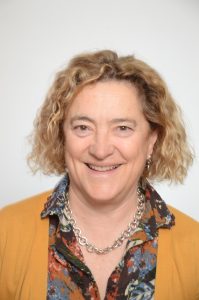
Miren Llona
 Doctorate in Contemporary History from the University of The Basque Country since 2000. Her doctoral thesis about the construction of women identities in the Bilbao middle-classes during the 20’s and 30’s won the Research Prize Victoria Kent from the Universidad de Málaga in 2001. From this research group she founded the Oral History Archive AHOA in 2004, where she is the current Chairwoman. From 2008 to 2012 she was a member of the Board of the International Oral History Association (IOHA) and between 2010 and 2012 she was Vice-President of the association. She is also the president of the Women’s Documentation Center Centro de Documentación de Mujeres Maite Albiz Emakumeen Dokumentazio Zentrua, since 2004. She has been from 2020-2022 the president of the Asociación Española de Investigación de Historia de las Mujeres (AEIHM).
She teaches Contemporary History at the Faculty of Social and Communication Sciences from the University of The Basque Country as well as in the Master of feminist and gender studies, in the Master of Contemporary History and in the online Master of equal opportunities at the University of The Basque Country.
Her research lines focus on three areas, the construction of contemporary identities from a national, class and gender perspective in the Basque Country; oral history and the analysis of memory from a cultural perspective and gender history, and the study of the power relations between men and women.
She has written the following books:
- Entre señorita y garçonne. Historia oral de las mujeres bilbainas de clase media. 1919-1939, Universidad de Málaga (2002).
- Entreverse, teoría y metodología práctica de las fuentes orales, Universidad del País Vasco (2012).
- Con José Javier Díaz Freire (ed.), Tras la estela de los feminismos históricos, Granada, Comares, 2023.
- Con Margarita Sánchez (ed.), Tecnología, ciencia y naturaleza en la historia de las mujeres, Granada: Comares, 2023.
Other recent publications:
- “La memoria del feminismo y la batalla por la historia”, Historia con memoria en la educación, José Miguel Gastón y César Layana (eds.), Pamplona, Gobierno de Navarra, 2023, 33-40.
- Con Nerea Aresti, “Gender”, The Bloomsbury Handbook of the Spanish Civil War, Antonio Cazorla Sánchez (ed. lit.), Alison Ribeiro de Menezes, Adrián Shubert (ed. lit.), London New York, Bloomsbury Academic, 2023, 107-126.
- With Nerea Aresti, “Ser mujer en el mundo que habitó Clara Campoamor. Los ideales de género en el primer tercio del siglo XX”, Clara Campoamor Rodríguez. Mujer y ciudadanía (1888-1972) (ed. Rosa Mª Capel Martínez), Madrid, Sociedad Estatal de Conmemoraciones Culturales, 2022, 142-161.
- “Trayectorias feministas en el País Vasco durante los años treinta del siglo XX. Nuevas mujeres entre el cambio y la continuidad”, Una nueva historia de los feminismos ibéricos/ coord. por Silvia Bermúdez y Roberta Johnson, Tirant humanidades, Valencia, 2021, 327-337.
- “Trayectorias feministas en el País Vasco durante los años treinta del siglo XX. Nuevas mujeres entre el cambio y la continuidad”, Una nueva historia de los feminismos ibéricos/ coord. por Silvia Bermúdez y Roberta Johnson, Tirant humanidades, Valencia, 2021, 327-337.
- With Nerea Aresti, “Mary Nash, tras las huellas del feminismo histórico”. Mujeres, dones, mulleres, emakumeak. Estudios sobre la historia de las mujeres y del género (ed. Teresa M. Ortega, Ana Aguado y Elena Sánchez Sandoica), Madrid, Cátedra, 2019, 359-378
- “La señorita y las otras. Fronteras de clase y subjetividad femenina en el primer tercio del siglo XX en España”, en Henar Gallego y Mª del Carmen García Herrero, Autoridad, poder e influencia. Mujeres que hacen historia, Icaria, (2017), 105-129.
- “The Healing Effect of Discourses: Body, Emotions and Gender Subjectivity in Basque Nationalism”, en Rina Benmayor, et al., Memory, Subjectivities, and Representation: Approaches to Oral History in Latin America, Portugal, and Spain, Palgrave Macmillan, Palgrave (2016), 77-93.
- “E. P. Thompson, La formación de la clase obrera en Inglaterra, el feminismo y la historia de género”, en Julián Sanz, José Babiano y Francisco Erice, P. Thompson: marxismo e historia social. Miradas desde España, Siglo XXI (2016), 153-176.
- “From Militia Women to Emakume: Myths Regarding Femininity during the Civil War in the Basque Country”, en Aurora MorcilloMemory and Cultural History of the Spanish Civil War. Realms of Oblivion, Brill (2013), 179-213.
Articles in specialized magazines:
- With Nerea Aresti, “Susanna Tavera y Pilar Pérez-Fuentes: el compromiso con el feminismo y la historia”, Historia Social, 105 (2023)
- With Maialen Altuna, “Privilegios, fisuras y disidencias corporales: subjetividades femeninas de resistencia en el franquismo”, Ayer, 126 (2022).
- “Recordar el porvenir: las mujeres modernas y el desorden de género en los años veinte y treinta”, Arenal, 27 (2020).
- “La memoria de las otras: feminismo y recuerdo”, Mélanges de la Casa de Velázquez, 50 (2020).
- “La imagen viril de Pasionaria. Los significados simbólicos de Dolores Ibárruri en la II República y la Guerra Civil”, Historia y Política, 36 (2016).
- “Las contradicciones de la respetabilidad. Género y cultura política socialista en el primer tercio del siglo XX”, Historia Trabajo y Sociedad, 5 (2014).
- “Los otros cuerpos disciplinados. Relaciones de género y estrategias de autocontrol del cuerpo femenino, (primer tercio del siglo XX)”, Arenal, 14 (2007).
- “La Prostitución y la clase obrera en el tránsito del siglo XIX al XX. Un análisis de género a la obra literaria de Julián Zugazagoitia”, Historia Contemporánea, 33, (2006).
- “Género e identidad de clase. La construcción de la clase obrera vizcaína durante el primer tercio del siglo XX”, Historia Social, 54 (2006).
PERFILES
https://ehu.academia.edu/MirenLlona
https://dialnet.unirioja.es/servlet/autor?codigo=145762
http://orcid.org/0000-0001-5963-5543
EMAIL
miren.llona@ehu.eus